
On choosing
Shoplifters, FilmStack, and what makes a family

Welcome to The Lines Man. On the surface it has been quiet for a few weeks. But things are definitely happening.
As I plan my own pursuits for 2026, it’s been thrilling to see and feel the momentum building behind FilmStack. I’ll be attending next week’s first-ever UK IRL meet-up, and can’t wait (RSVP here if you wanna join - it’ll be what the kids call ‘lit’.)
With that in mind, before I dive into this newsletter, a few shout-outs to the FilmStack movers and shakers who’ve inspired me this month:
Appreciate you all. Goes without saying: I’ve probably forgotten someone, so do accept my apologies.
And without further ado, today’s newsletter….
What makes a family?
Big question. It’s one that Japanese director Hirokazu Kore-eda asks in many of his films, from Still Walking and Broker to one I watched for the first time recently: Shoplifters.
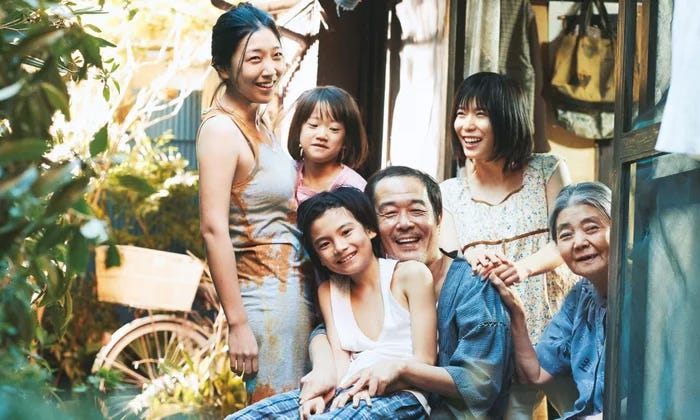
It was that film that moved me to write this essay. So often we hear the mantras ‘you can’t choose your family’ and ‘blood is thicker than water’. This film, delicate and deceptive in its piece-by-piece construction, upends both of those cliches.
Kore-eda is my favourite type of director: one that trusts his audience, and risks the gradual accumulation of information building towards the resolution of his theme. In Shoplifters, that is the question of how to survive on society’s margins, and the nature and durability of family bonds.
The film follows a family but - spoiler here - there is no biological or legal connection between anyone in it (bit like FilmStack, in a way), as we learn in the film’s devastating final act. Their bond is not predicated on the circumstance of blood but on survival.
But before we get to that denouement, Kore-eda does what he does best: placing us within the soft rhythm of domestic routines, mealtimes, banter. This allows us to see and feel the bonds created and elevated between the family members in almost real-time. All the better to leave us bereft when he lands the final twist.
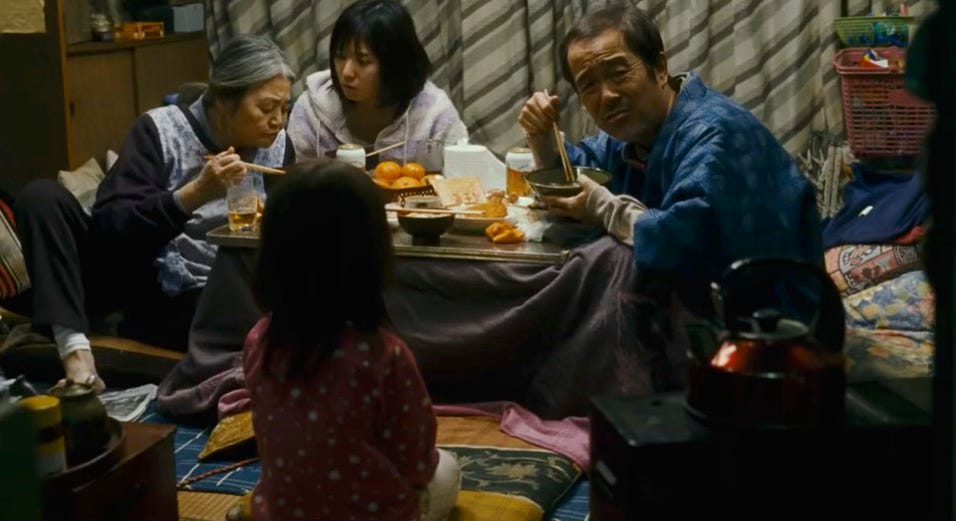
Side note: I recently watched another film - Riff Raff - which also looks at the question of whether you can choose your family, and the duty family asks. The two films are otherwise worlds apart but they both land in the same place: you can choose.
You can choose your family
This feels like an apt time to explore this right now for a few reasons.
Firstly, it’s coming up to Christmas. Family bonds - love or lack thereof - loom large at this time of year. In the whirlwind we can begin to wish we had the power to change it, as grateful as we may or may not be.
Secondly, as every cultural commentator from here to Proxima Centauri never tires of reminding us: we’re in a moment of increasing cultural and social atomisation. This is a sundering that impacts all kinds of bonds and makes us lonely in crowded rooms.
We need, now, to be able to make our own families. You can call these communities, if you like. But like the characters of Shoplifters, a new world means we are finding new ways to survive. We can do it together.
That’s why I’m so inspired by what’s going on with FilmStack and the NonDē movement at the moment.

(For the uninitiated, NonDē cinema - coined by
- is a movement for a new, “non-dependent” filmmaking ecosystem that aims to support independent artists by ensuring they retain ownership and control of their work. It’s going gangbusters across Substack atm.)Ted may not have kidnapped us all like Osamu - the shifty, wheedling patriarch of Shoplifters’s patchwork clan - but what we’re seeing at the moment is a coming together to find new ways to survive and thrive as creatives. All more important in a world which seems to want to strip creativity of its fundamental human element.
This is not limited to cinema or even to creativity. Around the world, there are signs that people are beginning to shake off the inertia of this century and becoming active in making their own families.
Young people coming together to help rewild the UK and accelerate nature recovery
The Mens Sheds movement using connection, conversation and creation to reduce loneliness
Gen Z turning away from phones and towards communal, tactile activities like chess, and crafts.
The family in Shoplifters isn’t all wholesome - we do see how damaging and untenable it ultimately is. But Kore-eda takes the time to show us affection and camaraderie, and only when it falls apart do we realise how precious it all was. At the end, we’re left to wonder whether there isn’t a better way to define a family.
Now, perhaps, there is.
I would include mutual aid groups born for the most part out of necessity during Covid but many continuing today
Beautiful. Have to watch this film!!